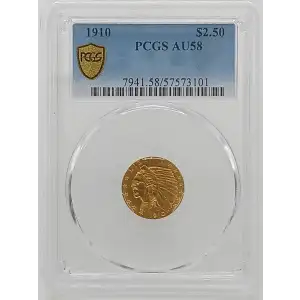
$20 Gold Double Eagles
Explore Liberty Head and Saint-Gaudens Double Eagles, including certified examples from historic U.S. mints.


Can't find what you want?
IDC Coin & Bullion | Classic American Gold
Explore historic United States gold coins, including Liberty Head Double Eagles, Saint-Gaudens $20 gold pieces, Liberty Head Half Eagles, $10 Gold Eagles, Indian Head gold coins, and early gold denominations.
Pre-1933 U.S. gold coins represent an important chapter in American monetary history. Originally issued for circulation and commerce, these coins are now collected for their gold content, historical significance, condition, mintmarks, and numismatic rarity.
IDC Coin & Bullion, part of International Diamond Center, offers classic American gold coins certified by services including PCGS, NGC, and ICG, along with eligible IDC Verified examples.
Browse available inventory below by denomination, coin series, date, mintmark, grading service, and grade. Review individual listings for exact attribution, condition, certification, and availability.
Explore Liberty Head and Saint-Gaudens Double Eagles, including certified examples from historic U.S. mints.
Discover Liberty Head and Indian Head designs representing two of America's classic gold denominations.
Browse $2.50 Quarter Eagles, Indian Head incuse designs, and collectible $1 gold coins.
 Read more about1834 $2.50 Gold Liberty Head Quarter Eagle ICG EF Quality Classic IDC Verified
 Read more about1900 $2.50 Gold Liberty Head Quarter Eagle PCGS Genuine - UNC Details (Scratch)
 Read more about1927 Gold Quarter Eagles $2 1/2 Indian Head PCGS MS-62
Call Us for more Information
Pre-1933 United States gold coins are classic American gold denominations associated with the period before major changes to federal gold policy in 1933.
These historic coins include gold dollars, $2.50 Quarter Eagles, $5 Half Eagles, $10 Eagles, and $20 Double Eagles. They were issued for monetary purposes and are now collected for their gold content, designs, historical significance, mintmarks, rarity, and condition.
Most standard U.S. gold coins produced after 1837 contain approximately 90% gold and 10% copper. Earlier coins may have different specifications.
Pre-1933 gold is distinct from modern American Gold Eagles and Gold Buffalos, which began in 1986 and 2006, respectively.
| Denomination | Face Value | Approximate Gold Content |
|---|---|---|
| Gold Dollar | $1 | 0.04837 troy oz |
| Quarter Eagle | $2.50 | 0.12094 troy oz |
| Half Eagle | $5 | 0.24187 troy oz |
| Eagle | $10 | 0.48375 troy oz |
| Double Eagle | $20 | 0.96750 troy oz |
These are approximate original specifications for standard classic issues under the relevant historical coinage standards. They do not account for circulation wear or metal loss.
Liberty Head gold coinage forms a major part of nineteenth-century American numismatics. The designs generally feature Liberty wearing a coronet and were produced across several denominations.
Produced from 1840 through 1907. Designed by Christian Gobrecht, these coins are collected by date, mintmark, and condition.
Produced from 1839 through 1908. Important to collectors of nineteenth-century gold and Southern branch-mint issues.
Produced from 1838 through 1907. Collectors study design subtypes, historic mintmarks, and scarce individual dates.
Introduced in 1850 and produced through 1907, these large gold coins became important in American commerce and banking.
The Liberty Head Double Eagle, designed by James B. Longacre, was introduced in 1850 following the California Gold Rush.
Each standard $20 Double Eagle contains approximately 0.9675 troy ounce of pure gold.
| Type | Years | Identifying Feature |
|---|---|---|
| Type I | 1850–1866 | No IN GOD WE TRUST motto on reverse. |
| Type II | 1866–1876 | Motto added; denomination reads TWENTY D. |
| Type III | 1877–1907 | Motto retained; denomination reads TWENTY DOLLARS. |
Collectors pursue Double Eagles by type, date, mintmark, certified grade, and historical provenance. Some examples trade near bullion-related levels, while scarce issues can command significant numismatic premiums.
Introduced in 1907, the Saint-Gaudens Double Eagle features one of the most celebrated designs in American coinage.
The obverse depicts Liberty advancing with a torch and olive branch. The reverse features an eagle flying above the rising sun.
Standard Saint-Gaudens Double Eagles contain approximately 0.9675 troy ounce of gold.
The 1907 High Relief issue is a historically important early version of the design, featuring more pronounced relief than later regular issues.
Early Saint-Gaudens Double Eagles were issued without IN GOD WE TRUST. The motto was restored in 1908, creating collectible design varieties.
Collectors commonly seek certified examples dated 1924 and 1928, along with scarcer issues and better-preserved examples.
The $2.50 Indian Head Quarter Eagle was designed by Bela Lyon Pratt. Its distinctive incuse design places major design elements below the surrounding coin surface.
Each standard issue contains approximately 0.12094 troy ounce of pure gold.
The $5 Indian Head Half Eagle also features Pratt's incuse design. These coins contain approximately 0.24187 troy ounce of pure gold.
Collectors examine the surfaces carefully because wear and preservation can appear different from raised-relief coin designs.
Designed by Augustus Saint-Gaudens, the $10 Indian Head Eagle depicts Liberty wearing a feathered headdress.
The reverse features a standing eagle. Collectors study No Motto and With Motto varieties, dates, mintmarks, and certified grades.
United States gold dollars were produced from 1849 through 1889. They are among the smallest circulating gold denominations issued by the U.S. Mint.
The series includes three major design types: Liberty Head, Small Indian Head, and Large Indian Head.
Gold dollars are popular with type collectors and specialists in early American gold denominations.
The current IDC category includes a certified 1852 Liberty Head Gold Dollar, subject to availability.
Mintmarks help identify where a classic American gold coin was produced.
| Mintmark | Mint Facility |
|---|---|
| No mintmark | Philadelphia, Pennsylvania |
| C | Charlotte, North Carolina |
| CC | Carson City, Nevada |
| D | Dahlonega, Georgia, or Denver, Colorado, depending on date |
| O | New Orleans, Louisiana |
| S | San Francisco, California |
Dahlonega and Denver both used the letter D, but in different historical periods. The date and coin series determine the correct attribution.
Charlotte and Dahlonega branch-mint gold coins are particularly interesting to collectors of Southern U.S. numismatics.
Some classic gold coins are relatively common survivors, while others are important numismatic rarities.
Scarcity may depend on original mintage, surviving population, date, mintmark, and certified condition.
Specialists also collect varieties such as the 1873 Open 3 and Closed 3 date styles.
Documented shipwreck or hoard provenance may add historical significance and collector interest. Such claims should be supported by reliable attribution.
Professional grading services such as PCGS, NGC, ICG, and ANACS authenticate eligible classic gold coins and evaluate their condition.
| Grade | General Description |
|---|---|
| VF-20 to VF-35 | Very Fine; moderate circulation wear. |
| XF-40 to XF-45 | Extremely Fine; light wear on high points. |
| AU-50 to AU-58 | About Uncirculated; slight wear. |
| MS-60 to MS-62 | Mint State; no circulation wear, with noticeable imperfections. |
| MS-63 to MS-64 | Mint State; improved preservation and eye appeal. |
| MS-65 to MS-70 | Higher Mint State grades indicating stronger preservation. |
| Details / Genuine | Authentication or condition notation that may identify cleaning, damage, or other issues. |
A straight numerical grade differs from a Details or Genuine designation. Collectors should also evaluate strike, surface originality, luster, and eye appeal.
Descriptive terms such as AU Quality, EF Quality, or BU Quality should not automatically be treated as exact numerical grades.
IDC Verified identifies eligible coins participating in IDC's numismatic verification program, incorporating independent grading through Independent Coin Graders (ICG).
Participating coins should be evaluated using their actual holder, assigned grade, certification number, and any condition or variety notations.
Not every ICG-certified coin is necessarily IDC Verified.
| Feature | Classic U.S. Gold | Modern U.S. Gold Bullion |
|---|---|---|
| Historical period | Classic U.S. coinage | Modern bullion programs |
| Typical composition | 90% gold for many standard classic issues | 22K Gold Eagles; .9999 Gold Buffalos |
| Collecting focus | Date, mintmark, type, history, condition | Metal content, design, finish, certified grade |
| Pricing considerations | Gold value plus possible numismatic premium | Gold value plus bullion or collector premium |
Neither category guarantees appreciation. Gold prices and numismatic premiums fluctuate independently.
Actual gold weight and the gold spot price provide a metal-value reference.
Some historic issues are significantly scarcer than others.
Wear, luster, cleaning, scratches, and eye appeal influence collector demand.
Recognized varieties and documented historical associations may add value.
Compare recent market transactions involving the same date, mintmark, grade, and condition. A published price guide is a reference, not a guaranteed sale price.
Begin by selecting a denomination, coin design, or historical period.
Verify the coin's year, mintmark, gold specifications, and certification.
Examine available photographs and disclosed condition information. Pay special attention to cleaned, damaged, or Details-graded coins.
Compare asking prices with relevant numismatic sales and the coin's underlying gold value.
IDC Coin & Bullion, part of International Diamond Center, is headquartered in Clearwater, Florida.
IDC operates 11 retail locations across Florida and Georgia and sells collectible gold coins nationwide through its online store.
Collectors throughout Clearwater, Tampa, St. Petersburg, Largo, Dunedin, Palm Harbor, Safety Harbor, Oldsmar, and the greater Tampa Bay area can contact IDC about classic American gold coins.
Have Liberty Head gold coins, Saint-Gaudens Double Eagles, Indian Head gold, or a larger pre-1933 gold collection to sell?
IDC considers qualifying coins and collections for purchase.
Historic United States gold coins associated with the period before major federal gold-policy changes in 1933, including gold dollars, Quarter Eagles, Half Eagles, Eagles, and Double Eagles.
Most standard classic U.S. gold coins contain 90% gold and 10% copper, rather than pure 24-karat gold.
A standard Liberty Head or Saint-Gaudens $20 Double Eagle contains approximately 0.9675 troy ounce of pure gold.
A standard $10 Eagle contains approximately 0.48375 troy ounce of pure gold.
A standard $5 Half Eagle contains approximately 0.24187 troy ounce of pure gold.
A historic U.S. gold coin with a face value of $2.50.
They are different $20 gold coin designs. Liberty Head Double Eagles were issued from 1850 through 1907; Saint-Gaudens Double Eagles were issued from 1907 through 1933.
A $2.50 or $5 Indian Head gold coin designed by Bela Lyon Pratt with major design elements recessed below the surrounding surface.
It may indicate Dahlonega, Georgia, or Denver, Colorado, depending on the coin's date and series.
A historic U.S. gold coin struck at the Charlotte Mint in North Carolina and identified by a C mintmark.
Some are. Numismatic premiums depend on rarity, condition, date, mintmark, varieties, and market demand.
About Uncirculated grade 58, generally indicating slight circulation wear with substantial remaining original detail and luster.
A grading-service designation identifying evidence of cleaning and a descriptive condition assessment rather than a standard straight numerical grade.
An IDC numismatic verification program for eligible participating coins incorporating independent grading through ICG.
Many classic U.S. gold coins are legally owned and traded by private collectors. Certain exceptional issues, including 1933 Double Eagles, have special legal histories.
Yes. IDC offers certified classic U.S. gold coins through its online catalog, subject to current inventory.
IDC considers qualifying historic U.S. gold coins and collections for purchase.
IDC Coin & Bullion is headquartered in Clearwater, Florida, and sells classic U.S. gold coins through its online store.
Explore Liberty Head Double Eagles, Saint-Gaudens gold, Indian Head Quarter Eagles and Half Eagles, $10 Eagles, and historic U.S. gold denominations.
Browse current inventory online or contact IDC about classic gold coins you are considering selling.