



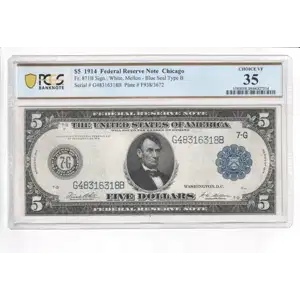


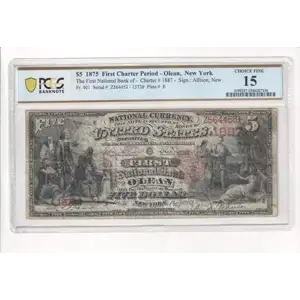


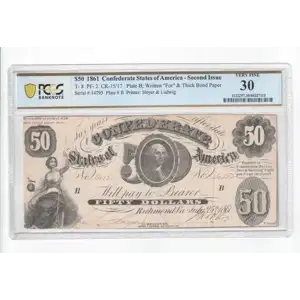


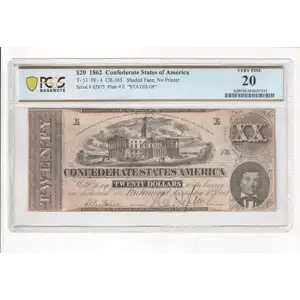


Collecting United States Paper Money
United States paper money offers collectors a remarkable record of American history, banking, commerce, and monetary development. The collecting and study of paper currency is known as notaphily.
American banknotes include government-issued currency, notes issued by federally chartered national banks, and historic obligations of private banks and other institutions.
Collectors may specialize by note type, denomination, series year, seal color, issuing bank, Friedberg number, geographic location, or condition.
At IDC Coin & Bullion, collectors can explore historic American banknotes and compare available inventory by issue and grade.
Types of Collectible U.S. Paper Money
Continental Currency
Paper currency issued by the Continental Congress during the American Revolutionary War. Collectors examine dates, denominations, varieties, signatures, and condition.
Obsolete Banknotes
Historic notes issued by state banks, private banks, railroads, and other institutions before or during the nineteenth century. Many are no longer redeemable.
Demand Notes
Early federal paper currency issued beginning in 1861. Demand Notes represent an important transition in U.S. monetary history.
Legal Tender Notes
Also known as United States Notes, these include historic red-seal currency, Rainbow Notes, Bison Notes, and other collectible varieties.
Silver Certificates
U.S. currency historically associated with redemption in silver. Collectors pursue large-size and small-size issues, including the Educational Series.
Gold Certificates
Historic currency representing gold held by the U.S. Treasury. Large-size and small-size Gold Certificates are important numismatic specialties.
National Bank Notes
Currency issued by federally chartered national banks. Notes are identified by bank name, town, state, charter number, and type.
Treasury & Coin Notes
Treasury Notes of 1890 and 1891 are notable for distinctive designs, denominations, and collectible varieties.
Federal Reserve Bank Notes
Historic obligations of individual Federal Reserve Banks, including large-size 1915 and 1918 issues and later small-size notes.
Federal Reserve Notes
The familiar modern U.S. banknote type, also collected for older series, scarce varieties, replacement notes, and high denominations.
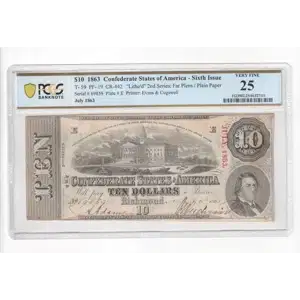
Confederate Currency
Paper money issued by the Confederate States of America during the Civil War. Identification requires attention to types, varieties, and counterfeits.
High-Denomination Currency
Collectible U.S. notes include historic $500 and $1,000 denominations, as well as scarcer higher-denomination issues.
Large-Size vs. Small-Size U.S. Currency
One of the most important distinctions in American paper money collecting is the difference between large-size and small-size notes.
| Feature | Large-Size Notes | Small-Size Notes |
|---|---|---|
| Period | Federal issues primarily before the 1928 size redesign | Introduced with the Series of 1928 |
| Approximate Dimensions | 7.42 × 3.13 inches | 6.14 × 2.61 inches |
| Popular Types | Legal Tender Notes, Silver Certificates, Gold Certificates, National Bank Notes | Federal Reserve Notes, Silver Certificates, Legal Tender Notes, 1929 Nationals |
| Collector Focus | Historic engravings, seal varieties, type notes, bank history | Series, districts, star notes, serial numbers, condition |
The distinction is useful when identifying and organizing a collection, but rarity and value depend on the individual issue.
National Bank Notes: Collecting Currency by Town & State
National Bank Notes are especially appealing because they connect American currency to local banking and community history.
Collectors often seek notes from particular towns, counties, states, or banks. These are sometimes called hometown notes.
Important identifying details include the issuing bank's title, charter number, denomination, note type, series, and bank officers' signatures.
Florida National Bank Notes
Florida National Bank Notes are particularly relevant to collectors interested in the state's economic and banking history.
IDC's catalog has included National Bank Notes associated with St. Petersburg, Jacksonville, Palatka, and DeFuniak Springs.
Collectors may also research notes from Tampa, Clearwater, Orlando, Miami, and other Florida communities, where applicable historic national bank issues exist.
Famous U.S. Banknotes & Popular Collecting Specialties
1869 Rainbow Notes
Named for their colorful appearance, the 1869 Legal Tender issues are among the most recognizable large-size American banknotes.
1896 Educational Series
The 1896 Silver Certificates are celebrated for their elaborate allegorical artwork on the $1, $2, and $5 notes.
1901 Bison Note
The 1901 $10 Legal Tender Note features an American bison and is a popular collectible type.
1918 Battleship Note
The large-size 1918 $2 Federal Reserve Bank Note is known for its battleship reverse design.
1890 Grand Watermelon
The 1890 $1,000 Treasury Note earned its nickname from the distinctive numeral design on its reverse.
1934 High-Denomination Notes
Historic $500 and $1,000 Federal Reserve Notes are sought by collectors of discontinued denominations.
These collecting specialties vary substantially in rarity and market price. Browse the product listings above to see which examples are currently available.
What Is a Friedberg Number?
A Friedberg number, commonly written as Fr. or FR#, is a catalog reference used to identify United States paper money varieties.
Friedberg references help distinguish notes by series, denomination, signatures, seal types, and other characteristics.
Two banknotes with the same denomination and apparent design may have different Friedberg numbers.
IDC's paper money catalog includes Friedberg references in many product titles, making it easier for experienced collectors to identify specific issues.
How Is Rare U.S. Paper Money Graded?
Condition is an essential consideration when purchasing collectible currency. Notes are evaluated for folds, creases, tears, staining, repairs, trimming, and original paper quality.
| Grade | General Description |
|---|---|
| Gem Uncirculated | Uncirculated note with high-quality presentation and few imperfections under the grading standard. |
| Choice Uncirculated | No circulation wear, but may have centering or other imperfections. |
| About Uncirculated (AU) | Very light handling or limited circulation evidence. |
| Extremely Fine (EF/XF) | Light circulation wear and relatively strong paper quality. |
| Very Fine (VF) | Moderate circulation wear and visible folds. |
| Fine (F) | Considerable wear while major design elements remain recognizable. |
| Very Good (VG) | Heavy wear, folding, and reduced paper quality. |
PMG & PCGS Banknote Certification
Professional paper money grading services authenticate eligible banknotes and assign grades using established standards.
A certified holder may document the note's type, variety, grade, and identified problems.
Certain designations, such as PMG's Exceptional Paper Quality (EPQ), describe qualifying paper originality and quality.
Certification can assist with comparison and authentication, but does not guarantee future value or liquidity.
What Makes Old U.S. Paper Money Valuable?
Rarity
Scarce varieties, limited survival, and unusual issues may command collector premiums.
Condition
Original, well-preserved notes may be more desirable than heavily circulated examples.
Historical Significance
Notes associated with major historical events or distinctive designs may attract specialized collectors.
Collector Demand
Interest varies by denomination, issue, location, variety, and market conditions.
Star Notes & Fancy Serial Numbers
Some collectors specialize in replacement notes, commonly identified by a star in the serial number on many modern U.S. issues.
Fancy serial numbers may include low numbers, solid numbers, repeaters, ladders, and radar or palindrome patterns.
An unusual serial number does not automatically guarantee a substantial premium.
How to Store & Protect Collectible Currency
Paper money should be protected from moisture, sunlight, adhesives, unnecessary handling, and unsuitable storage materials.
Use archival-quality, currency-safe holders and maintain stable storage conditions.
Avoid cleaning, pressing, taping, laminating, or chemically treating collectible banknotes.
Professionally graded notes should generally remain in their certified holders.
Buy & Sell Rare Paper Money in Clearwater, Florida
IDC Coin & Bullion, part of International Diamond Center, is headquartered in Clearwater, Florida.
IDC serves collectors nationwide through its ecommerce website and operates through 11 retail locations across Florida and Georgia.
Collectors in Clearwater, Tampa, St. Petersburg, Largo, Palm Harbor, Dunedin, Safety Harbor, and the greater Tampa Bay area can contact IDC about American paper currency.
Have a collection of Silver Certificates, National Bank Notes, Confederate currency, obsolete banknotes, or other historic paper money?
Contact IDC to discuss whether your items meet current purchasing criteria.
Visit What Do We Buy? or explore IDC retail locations .
Confirm evaluation availability before bringing a large or specialized currency collection to a showroom.
U.S. Paper Money: Frequently Asked Questions
Where can I buy rare U.S. paper money online?
IDC Coin & Bullion offers collectible United States paper currency through its online catalog, including historic and certified notes.
What is a National Bank Note?
A National Bank Note is currency issued by a federally chartered national bank under the National Banking system.
What is a Silver Certificate?
A Silver Certificate is a historic form of U.S. paper currency once redeemable in silver under applicable Treasury rules.
What is a Legal Tender Note?
A Legal Tender Note, also known as a United States Note, is a form of federally issued paper currency.
What are obsolete banknotes?
Obsolete banknotes are historic currency issues from banks or other institutions that are no longer circulating as money.
What is a Friedberg number?
A Friedberg number is a catalog reference used to identify specific varieties of United States paper money.
What is a Rainbow Note?
Rainbow Notes are colorful Legal Tender issues from the Series of 1869.
What is an Educational Series note?
The Educational Series refers to the artistic 1896 Silver Certificates issued in $1, $2, and $5 denominations.
Are old $500 and $1,000 bills collectible?
Yes. Historic high-denomination U.S. currency is actively collected, with value depending on issue, rarity, and condition.
Are all old U.S. banknotes valuable?
No. Many older banknotes remain common. Rarity, condition, variety, and demand determine potential collectible premiums.
What is a star note?
A star note is a replacement note identified by a star in the serial number on many U.S. issues.
What does PMG EPQ mean?
EPQ means Exceptional Paper Quality, a PMG designation used for notes meeting its applicable paper quality criteria.
Can rare U.S. currency be professionally graded?
Yes. Eligible U.S. banknotes can be authenticated and graded by services such as PMG and PCGS Banknote.
Does IDC buy old paper money?
IDC purchases qualifying numismatic items. Contact the team about your specific currency or collection.
Can I sell Florida National Bank Notes to IDC?
Contact IDC about Florida National Bank Notes and other collectible currency to confirm current purchasing interest.
Where can I find a paper money dealer in Clearwater?
IDC Coin & Bullion is headquartered in Clearwater, Florida. Contact IDC about collectible American currency and available evaluation services.
Explore More Paper Money & Numismatics
Shop Rare United States Paper Money at IDC
Explore historic American banknotes, National Bank Notes, Silver Certificates, Legal Tender Notes, obsolete currency, and professionally graded collectibles.
Browse available inventory online or contact IDC about a paper money collection you are considering selling.
