United States Paper Money
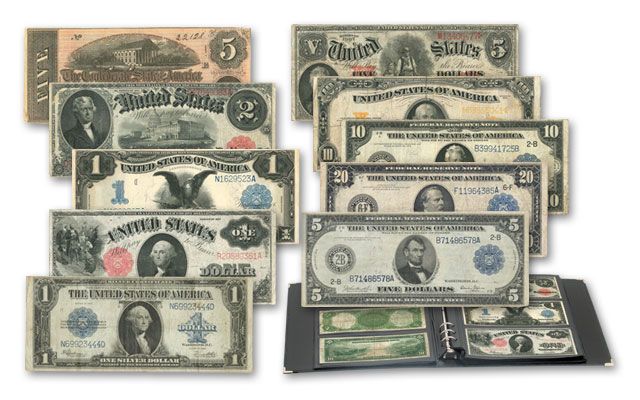
Explore National Bank Notes, Silver Certificates, Legal Tender Notes, Gold Certificates, obsolete currency, and historic American banknotes.
Shop U.S. Paper Money →

Can't find what you want?
IDC Coin & Bullion | Numismatics
Explore historic American currency, Canadian banknotes, world paper money, and distinctive collectible notes at IDC Coin & Bullion.
Paper money collecting combines history, art, economics, and numismatics. From early American banknotes to currency issued by countries around the world, collectible notes tell the story of monetary systems, governments, and commerce.
IDC Coin & Bullion, part of International Diamond Center, offers collectors access to rare U.S. paper money, professionally graded currency, and other collectible banknotes through its online catalog.
Browse the categories below to explore current inventory and learn more about different areas of paper money collecting.
Explore National Bank Notes, Silver Certificates, Legal Tender Notes, Gold Certificates, obsolete currency, and historic American banknotes.
Shop U.S. Paper Money →Learn about Dominion of Canada notes, Bank of Canada series, Devil's Face varieties, replacement notes, and historic Canadian currency.
Explore Canadian Banknotes →Discover international banknotes, historic currencies, former-country issues, and collectible notes from around the world.
Explore World Paper Money →Explore modern Goldback notes containing fractional amounts of gold, with distinctive artwork and collectible designs.
Shop Goldback Notes →Inventory note: Product availability varies by category. Some collecting categories may have no active listings at a given time. Browse each category for current products and pricing.
Paper money collecting, known as notaphily, is the study and collection of banknotes, currency, and related paper monetary instruments.
Collectible currency includes historic United States banknotes, Canadian paper money, international banknotes, obsolete issues, and professionally certified notes.
Unlike bullion, whose value is closely connected to precious metal content, collectible paper money is valued primarily for its numismatic characteristics.
These characteristics include rarity, condition, historical importance, recognized varieties, and collector demand.
At IDC Coin & Bullion, collectors can explore available paper money inventory online and learn about the different types of historic currency.
American paper money includes Legal Tender Notes, Silver Certificates, Gold Certificates, National Bank Notes, Federal Reserve Notes, and historic obsolete currency.
Canadian paper money includes chartered bank notes, Dominion of Canada currency, Bank of Canada issues, and modern polymer notes.
Foreign paper money reflects the history and monetary systems of countries throughout Europe, Asia, Africa, the Americas, and Oceania.
Obsolete notes include currency issued by institutions or authorities whose notes are no longer in circulation.
Third-party graded banknotes may be authenticated, attributed, and assigned numerical grades by professional currency grading services.
Collectors may pursue replacement notes, printing errors, fancy serial numbers, commemorative issues, and modern collectible notes.
Banknotes are historical documents as well as monetary instruments. Their portraits, engravings, signatures, and security features reflect the time and place in which they were issued.
Revolutionary War currency, Civil War-era notes, and historic national bank issues connect collectors with American monetary history.
Banknotes often feature elaborate artwork, portraits, architecture, allegorical figures, and intricate printing.
National Bank Notes and obsolete currency can document historic banks, towns, and regional economies.
Foreign banknotes reflect changing borders, governments, economic reforms, and national identities.
Not every old banknote is rare, and age alone does not establish collectible value.
The market value of a collectible banknote depends on several interacting factors.
| Factor | Why It Matters |
|---|---|
| Rarity | Scarce issues, varieties, and low surviving populations may attract stronger collector interest. |
| Condition | Original paper quality, wear, folds, stains, repairs, and handling can influence value. |
| Issue & Series | Different dates, signatures, denominations, and designs may have different levels of scarcity. |
| Historical Significance | Currency associated with important historical periods may appeal to specialized collectors. |
| Serial Numbers | Low numbers, replacement notes, and recognized fancy serial patterns can influence desirability. |
| Authentication | Correct attribution and confirmation of authenticity are important, especially for expensive notes. |
| Collector Demand | Market interest varies by collecting specialty, rarity, and available supply. |
Banknote condition is commonly described using established descriptive grades and, for certified notes, numerical grades.
| General Grade | Typical Characteristics |
|---|---|
| Uncirculated (UNC) | No circulation wear, although production or handling imperfections may be present. |
| About Uncirculated (AU) | Very limited handling or circulation evidence. |
| Extremely Fine (EF/XF) | Light circulation wear with strong overall appearance. |
| Very Fine (VF) | Moderate circulation wear, folds, and handling. |
| Fine (F) | Substantial circulation wear with major design elements generally visible. |
| Very Good (VG) | Heavy wear and reduced paper quality. |
| Good (G) | Extensive wear while the note remains identifiable. |
Professional paper money grading services, including PMG and PCGS Banknote, authenticate and grade eligible banknotes.
Certified holders may identify a note's type, denomination, series, grade, and recognized varieties.
Certain notes may also receive paper-quality designations under the grading service's published standards.
Certification can assist collectors in comparing notes, but it does not guarantee a specific market value or future investment return.
Accurate identification is essential when buying or selling rare currency.
Before researching a banknote's value, examine its issuing authority, denomination, series, signatures, serial number, condition, and catalog reference.
United States paper money is frequently identified using Friedberg catalog numbers, commonly abbreviated as Fr. or FR#.
World banknotes are often identified using Pick numbers, associated with the Standard Catalog of World Paper Money.
Canadian collectors commonly use specialized catalog references, including Charlton numbering systems, to identify issues and varieties.
Correct catalog attribution helps distinguish similar notes that may have substantially different collector values.
Whether purchasing your first historic banknote or adding a rare variety to an established collection, careful identification and condition assessment are important.
Decide whether to focus on U.S. currency, Canadian banknotes, world paper money, historic issues, or a particular series or denomination.
Review the issuer, date, denomination, catalog reference, signatures, and recognized varieties.
Examine available photographs and grading information. Pay attention to repairs, damage, and originality.
Consider relevant comparable sales, scarcity, condition, and current collector demand before purchasing.
Store notes in appropriate holders and avoid unnecessary handling or alterations.
Proper storage helps preserve banknote condition and long-term collectibility.
Use archival-quality, currency-safe holders and maintain stable storage conditions. Avoid exposure to moisture, excessive heat, sunlight, and adhesives.
Do not wash, press, tape, laminate, or chemically treat collectible banknotes. These actions can damage the note or affect its numismatic value.
Professionally graded banknotes should generally remain in their certified holders.
If you have inherited paper currency, accumulated a collection, or discovered old banknotes among family belongings, accurate identification is an important first step.
A collection may contain common notes, scarce varieties, certified currency, or historically significant issues.
IDC Coin & Bullion purchases qualifying numismatic items. Contact IDC to discuss the specific notes or collection you are considering selling.
Before visiting, organize any available documentation, grading certificates, and inventory records. Avoid cleaning or altering the notes.
Learn more on our What Do We Buy? page.
IDC Coin & Bullion, part of International Diamond Center, is headquartered in Clearwater, Florida.
IDC serves collectors nationwide through its online store and operates a network of 11 retail locations in Florida and Georgia.
Collectors in Clearwater, Tampa, St. Petersburg, Largo, Palm Harbor, Dunedin, Safety Harbor, Oldsmar, and surrounding Tampa Bay communities can contact IDC about collectible coins and paper currency.
Whether you are interested in National Bank Notes, Silver Certificates, historic U.S. currency, or international banknotes, browse available inventory online or contact the team about your collecting interests.
If you have paper money to sell, confirm evaluation availability before bringing a specialized collection to a showroom.
Find an IDC location or call (727) 572-6323 .
Collectible paper money includes banknotes and other paper currency sought for their historical, artistic, or numismatic importance.
Notaphily is the collecting and study of paper money.
IDC Coin & Bullion offers collectible U.S. currency and maintains categories for Canadian and world paper money. Available inventory varies.
Value depends on rarity, condition, issue, variety, historical significance, and collector demand.
No. Many older banknotes were produced in large quantities and remain common.
A National Bank Note is currency issued by a federally chartered national bank under the U.S. National Banking system.
A Silver Certificate is a historic type of U.S. paper currency formerly redeemable in silver under applicable rules.
A Gold Certificate is historic U.S. paper currency representing gold held by the Treasury under its original monetary framework.
A Friedberg number is a catalog reference used to identify specific U.S. paper money issues.
A Pick number is a catalog reference commonly used for world paper money.
On many U.S. currency issues, a star in the serial number identifies a replacement note.
Yes. Eligible banknotes may be authenticated and graded by services such as PMG and PCGS Banknote.
No. Certification can document authenticity and condition, but market prices depend on other factors.
No. Cleaning, pressing, or chemically treating collectible banknotes can cause damage or reduce originality.
IDC purchases qualifying numismatic items. Contact the team about your specific banknotes or collection.
IDC maintains dedicated Canadian and World Paper Money categories. Product availability depends on current inventory.
IDC Coin & Bullion is headquartered in Clearwater, Florida. Browse available currency online or contact IDC about numismatic services.
Discover collectible U.S. banknotes, historic currency, certified paper money, and international collecting specialties.
Shop available inventory online or contact IDC about a paper money collection you are considering selling.
"Amazing service and hospitality from the staff at IDC! Jason was so attentive and patient in our search for our ideal watches. He took us through several options, had us try every watch we were interested in, took our information and continued searching for options. A few hours later, we had our watches on hold and ready for pick up! He located a watch that I LOVE, and a unique piece for my husband. We are grateful to have found our new Jeweler for many pieces to come!"

 Verified Customer
"We loved our experience at IDC. Jason was very kind and patient with us. My fiancée and I found good options for our wedding bands. He made sure we found what we were looking for and provided all the details we needed, including comfort, value, and style. We also felt safe and comfortable at their shop, thanks to the double doors and security guard."
Verified Customer
"Jason was absolutely amazing! Extremely professional and very knowledgeable in helping us with the ring selection process. We actually ended up taking his advice on the bands and are very happy with our decision. We absolutely enjoyed our wedding band shopping experience and would recommend Jason to future buyers as well!"
Verified Customer
"Lila was extremely helpful. My finance and I were on a tight time crunch to get wedding bands and she was very knowledgeable and swift with making sure we had rings for our ceremony. She suggested great bands and was so kind and honest through our selection. I will definitely return to IDC and always ask for Lila!"
Verified Customer
"Our experience with Lee and the staff at International Diamond Center was outstanding. Lee’s interest was helping us find the right ring and diamond. He was straight forward, honest, and patient. We found the perfect ring and diamond at a fair price. appreciated the communication after the sale keeping us informed on the status of my wife’s new 40th anniversary wedding ring."
Verified Customer