Can't find what you want?
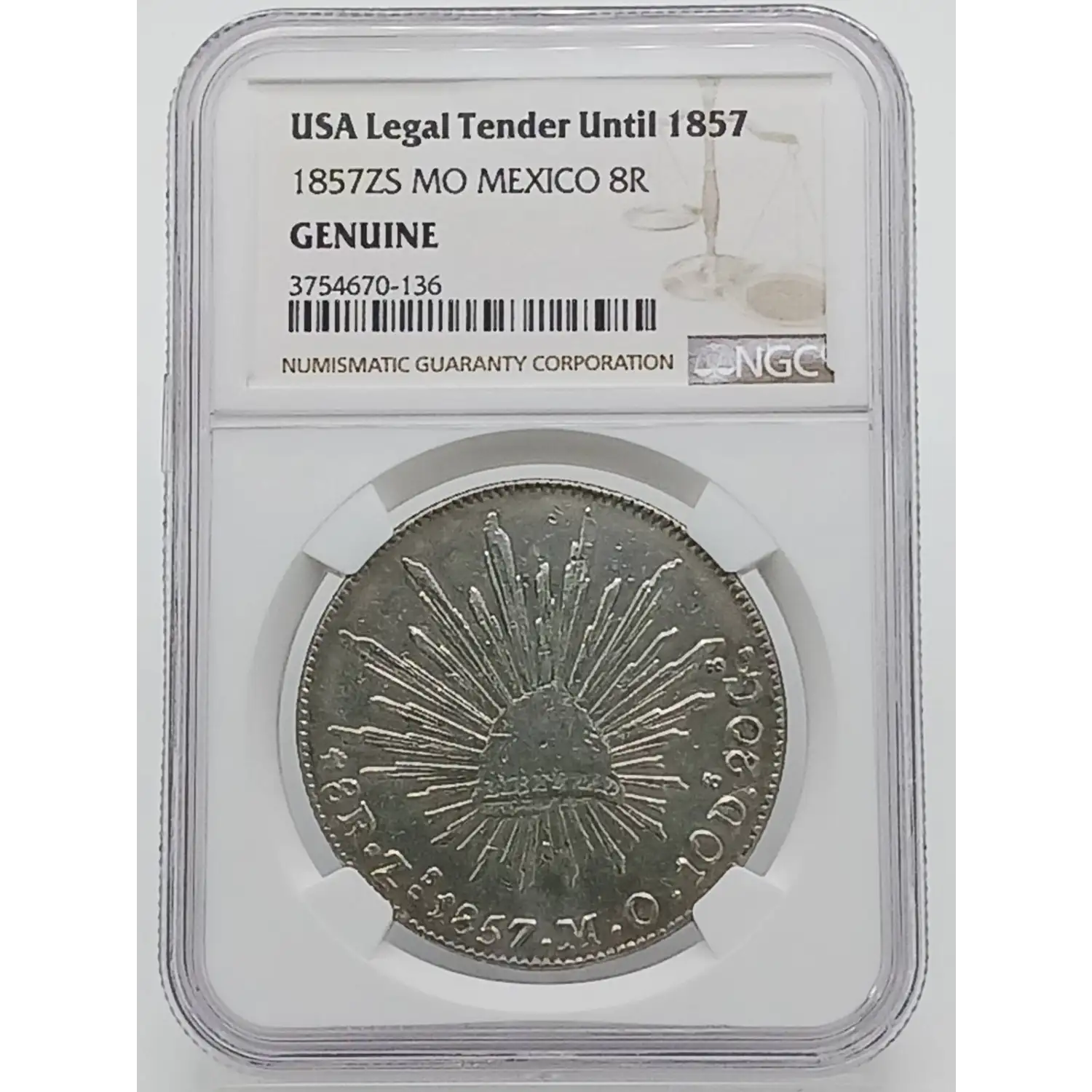
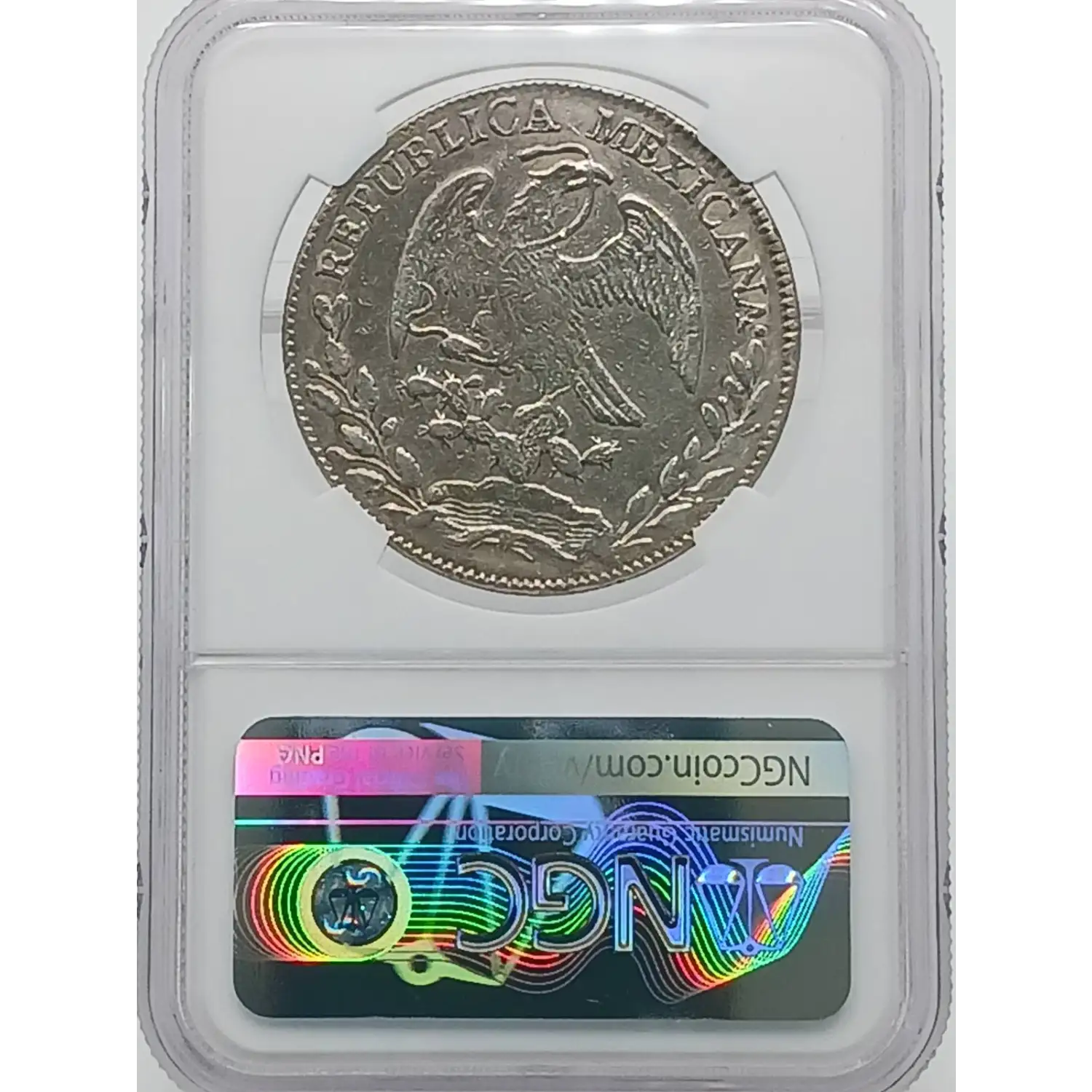
USA Legal Tender Until 1857- 1857-ZS MO Mexico 8R NGC Genuine
USA Legal Tender Until 1857- 1857-ZS MO Mexico 8R NGC Genuine
Item Identification
- Country: Republic of Mexico
- Denomination: 8 Reales ("Cap & Rays")
- Year: 1857
- Mint Mark: ZS (Zacatecas Mint)
Technical Specifications
- Composition: 90.3% Fine Silver (0.9030)
- Total Weight: 27.07 grams
- Actual Silver Weight (ASW): 0.7859 troy oz
- Diameter: ~39.0 mm
- Edge Style: Patterned / Reeded
Historical Provenance
- U.S. Legal Tender: Circulated actively within the United States alongside domestic currency to combat severe domestic bullion shortages until the U.S. Coinage Act of 1857 legally revoked foreign coin tender status.
- Civil War Circulation: Highly utilized as emergency species throughout the Confederate States of America during the Union naval blockades due to its highly trusted, static silver value.
Design Features
- Obverse (Front): Features the Mexican National Emblem—a Mexican Golden Eagle perched upon a blooming nopal cactus, clutching a rattlesnake. Semi-circled by the upper inscription REPUBLICA MEXICANA.
- Reverse (Back): Centered by a highly radiant Phrygian liberty cap emblazoned with the incuse text LIBERTAD. The lower periphery features the structural assay parameters: 8R.Z.1857.M.O.10Ds.20Gs.
The Unofficial Confederate Silver Dollar
When the American Civil War broke out, the United States Mint cut off the South from receiving any new federal coinage. The newly formed Confederate government lacked the bullion and infrastructure to mint its own silver dollars.
To solve this, Southern merchants, citizens, and soldiers heavily relied on Mexican Cap & Rays 8 Reales. They were plunked down on saloon bars, used at supply counters, and carried in the pockets of soldiers. Because these coins were minted in massive quantities just across the border, they flowed naturally into Texas, Louisiana, and the rest of the South.
More Silver Than a U.S. Dollar
People trusted the Mexican 8 Reales implicitly because it was an exceptionally high-quality coin. Struck in 90.3% fine silver, it weighed 27.07 grams. It actually contained more pure silver than the official United States Seated Liberty silver dollar circulating at the time. Even when the public completely lost faith in paper currency, a Mexican 8 Reales was valued everywhere because of its raw precious metal content.
Legal Tender Status
The U.S. government had actually permitted foreign coins—including Mexican Reales—to be used as official legal tender in America for decades because the young U.S. Mint couldn't produce coins fast enough. While Congress officially revoked this status with the Coinage Act of 1857, the public completely ignored the ban when the Civil War hit. When hard currency vanished in 1862, these Mexican coins were happily accepted by both Union and Confederate citizens.
How to Read Your Coin
- If you look closely at the "Cap & Rays" side of the coin, you will see a string of letters and numbers stamped along the bottom rim. They tell a precise story:
- The Denomination: Look for 8 R. (8 Reales, equivalent to one dollar). They were also made in smaller fractional sizes like 4R, 2R, 1R, and 1/2R.
- The Mint Mark: A letter combo like Mo (Mexico City), Zs (Zacatecas), Go (Guanajuato), or Do (Durango) tells you exactly which Mexican mint struck it.
- The Silver Purity: It will explicitly state 10 Ds. 20 Gs. (10 Dineros, 20 Granos), which was the old Spanish way of denoting its 90.3% silver purity.
* Images are of actual product you would be receiving.
Related products

 Read more about2016 Silver Wedge-Tailed Eagle NGC PF-69 High Relief (BOX and COA) ULTRA-CAMEO


 Read more about2019 Canada Pride of Two Nations Set Maple Leaf Early Releases Modified PF 70


Customer Reviews
"Amazing service and hospitality from the staff at IDC! Jason was so attentive and patient in our search for our ideal watches. He took us through several options, had us try every watch we were interested in, took our information and continued searching for options. A few hours later, we had our watches on hold and ready for pick up! He located a watch that I LOVE, and a unique piece for my husband. We are grateful to have found our new Jeweler for many pieces to come!"
 Verified Customer
"We loved our experience at IDC. Jason was very kind and patient with us. My fiancée and I found good options for our wedding bands. He made sure we found what we were looking for and provided all the details we needed, including comfort, value, and style. We also felt safe and comfortable at their shop, thanks to the double doors and security guard."
Verified Customer
"Jason was absolutely amazing! Extremely professional and very knowledgeable in helping us with the ring selection process. We actually ended up taking his advice on the bands and are very happy with our decision. We absolutely enjoyed our wedding band shopping experience and would recommend Jason to future buyers as well!"
Verified Customer
"Lila was extremely helpful. My finance and I were on a tight time crunch to get wedding bands and she was very knowledgeable and swift with making sure we had rings for our ceremony. She suggested great bands and was so kind and honest through our selection. I will definitely return to IDC and always ask for Lila!"
Verified Customer
"Our experience with Lee and the staff at International Diamond Center was outstanding. Lee’s interest was helping us find the right ring and diamond. He was straight forward, honest, and patient. We found the perfect ring and diamond at a fair price. appreciated the communication after the sale keeping us informed on the status of my wife’s new 40th anniversary wedding ring."
Verified Customer