Can't find what you want?


2020 Great Britain 1 oz Silver The Royal Arms
| Qty. | Wire / Check | Credit / Debit Card |
|---|---|---|
| 1+ | $78.50 | $81.64 |
The first official Royal Arms of England dates back more than 800 years to the reign of the second Plantagenet King of England. King Richard I, better known as Richard the Lionheart, reigned for a decade at the close of the 12th century and is responsible for the adoption of the first official Royal Arms of the kingdom.
Coin Highlights:
- 2nd issue of the 1 oz British Silver Royal Arms coin!
- Impressive vision of the Royal Arms of England!
- Contains 1 Troy oz of .999 pure silver in BU condition.
- Bears a face value of 2 Pound sterling (GBP) backed by the government of Britain.
- Queen Elizabeth II features on the obverse.
- The Lion of England and Unicorn of Scotland supporting the modern Royal Arms of England.
- Designed by Timothy Noad.
Prior to the rule of King Richard I, his father King Henry II and other previous Anglo-Saxon and Danish kings used lions in the heraldry. This included the various Anglo-Saxon and Danish kingdoms, as well as the eventual unified English kingdom as established by Alfred the Great. However, Richard I is credited with adopting the Three Lions design that is now recognized globally as a central piece of the Royal Arms of the English monarch.
Queen Elizabeth II is featured on the obverse of all 2020 1 oz British Silver Royal Arms Coins. This right-profile bust of the Queen was developed in 2015 by Jody Clark, the youngest artist ever to create a monarch’s bust for the Royal Mint of England. In this design, Her Majesty wears the George IV State Diadem Crown.
Timothy Noad designed the modern depiction of the Royal Arms of England featured on the reverse of these 2020 1 oz British Silver Royal Arms Coin. The Crowned Lion of England supports the shield to the left, while the Unicorn of Scotland supports it on the right. The quartered shield is crowned and features within its quadrants the Three Lions of England in the first and fourth positions, with the Lion of Scotland in the second position and the Harp of Ireland in the third position.
Related products

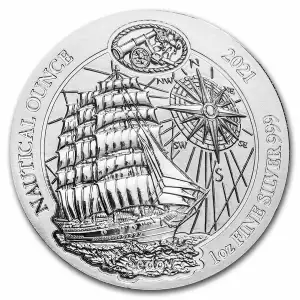
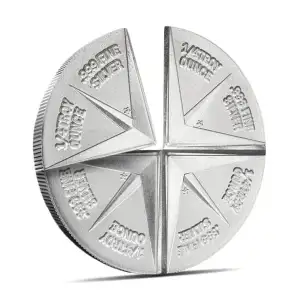 Read more about1 oz Divisible Compass Silver Round
Customer Reviews
"Amazing service and hospitality from the staff at IDC! Jason was so attentive and patient in our search for our ideal watches. He took us through several options, had us try every watch we were interested in, took our information and continued searching for options. A few hours later, we had our watches on hold and ready for pick up! He located a watch that I LOVE, and a unique piece for my husband. We are grateful to have found our new Jeweler for many pieces to come!"

 Verified Customer
"We loved our experience at IDC. Jason was very kind and patient with us. My fiancée and I found good options for our wedding bands. He made sure we found what we were looking for and provided all the details we needed, including comfort, value, and style. We also felt safe and comfortable at their shop, thanks to the double doors and security guard."
Verified Customer
"Jason was absolutely amazing! Extremely professional and very knowledgeable in helping us with the ring selection process. We actually ended up taking his advice on the bands and are very happy with our decision. We absolutely enjoyed our wedding band shopping experience and would recommend Jason to future buyers as well!"
Verified Customer
"Lila was extremely helpful. My finance and I were on a tight time crunch to get wedding bands and she was very knowledgeable and swift with making sure we had rings for our ceremony. She suggested great bands and was so kind and honest through our selection. I will definitely return to IDC and always ask for Lila!"
Verified Customer
"Our experience with Lee and the staff at International Diamond Center was outstanding. Lee’s interest was helping us find the right ring and diamond. He was straight forward, honest, and patient. We found the perfect ring and diamond at a fair price. appreciated the communication after the sale keeping us informed on the status of my wife’s new 40th anniversary wedding ring."
Verified Customer